

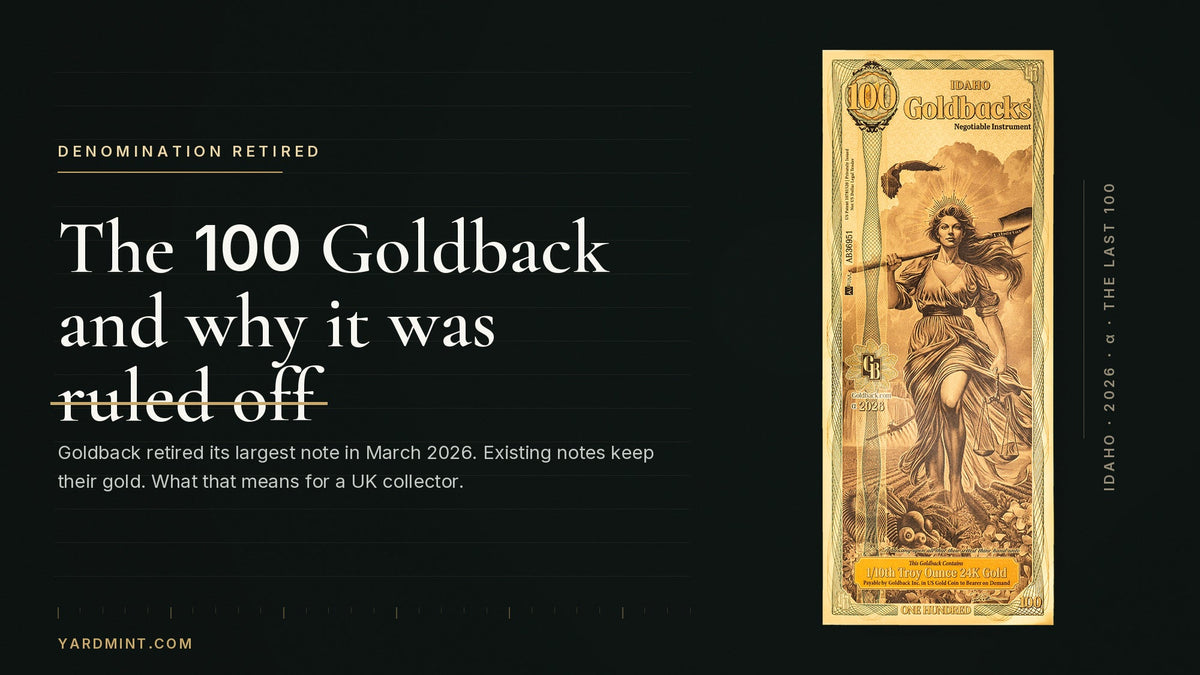
For about a year, the largest Goldback you could buy held a tenth of a troy ounce of gold and stood a head taller than every other note in the series. In March 2026 Goldback stopped making it. The decision says a great deal about what the project is actually for.
The short answer
Goldback announced on 26 March 2026 that the 100 denomination is discontinued. The reasons given were practical rather than dramatic: the note had become too valuable to spend, it accounted for more than half the cost of assembling a complete series, and it cost more than comparable one-tenth-ounce gold products already on the market. Existing 100 Goldbacks are unaffected. They keep their gold, and Goldback says they remain accepted within its network.
Five things worth knowing
- The 100 contained 1/10 troy ounce of 24-carat gold, the largest of any Goldback.
- Only four state series ever carried one: Florida, Oklahoma, Arizona and Idaho. Idaho was the last.
- Removing it roughly halves what a complete series costs to assemble, which was the stated point.
- Nothing changes for a note already in your hands. It is not withdrawn, recalled or devalued by the announcement.
- Discontinued is not the same as scarce. No mintage figures have been published, so nobody outside Goldback can substantiate a scarcity claim.
What the 100 Goldback actually was
Every Goldback holds a precise quantity of 24-carat gold sealed inside a durable polymer note, and the denomination tells you how much. A 1 Goldback holds 1/1,000 of a troy ounce. The ladder climbs from there, and the 100 sat at the top with 1/10 of an ounce, the same weight of gold as one hundred 1 notes stacked together. Our guide to Goldback denominations sets out the full ladder and the rule behind the numbers.
Because Goldbacks share a common width and grow taller as the denomination rises, the 100 was also physically the largest note in any series: noticeably taller in the hand, and a different object to look at.

Which series carried a 100
The denomination arrived with the 2025 series year and never spread beyond four states. Florida introduced it, Oklahoma and Arizona followed, and the Idaho series released in March 2026 was the last to include one. The older series that most UK collectors start with, including Utah, Nevada, New Hampshire, Wyoming and South Dakota, never had a 100 at all.

Why Goldback retired it
Goldback gave three reasons, and they are worth taking at face value because they are consistent with everything the project has said since it started.
1. It stopped being spendable
The whole argument for a gold note rather than a gold coin is that you can hand it over. Small denominations do that work. A note worth as much as the 100 sat in a wallet and stayed there. Goldback said plainly that it does not circulate as often as other denominations, which is a polite way of saying it had stopped behaving like currency and started behaving like a bar. Our piece on whether you can actually spend Goldbacks covers what circulation looks like in practice.
2. It priced a complete set out of reach
This is the argument with real force. In a series running from the quarter up to the 100, the largest note alone accounts for a little over half the gold in the whole set. Anyone trying to assemble one complete state series was therefore spending more on a single note than on the other eight combined. Take the 100 out and the cost of a full series roughly halves. Goldback framed that as making complete collections practical again, and on the arithmetic it is hard to argue with.

3. Cheaper one-tenth-ounce gold already existed
A Goldback carries a premium over its metal because of the artwork, the polymer format, the security layer and the labour involved. On a quarter or a 1 that premium buys you something no coin offers: gold in a quantity small enough to give away or spend. On a tenth of an ounce it competes directly with fractional coins and small bars that carry a much thinner premium. Goldback said as much. If you want to see how that premium behaves across the ladder, our guide to Goldback premiums goes through it denomination by denomination.

What replaced it, at the other end
The same strategy that removed the 100 introduced the quarter. Goldback has moved deliberately towards the small end of the ladder, where the format does something a coin cannot. The quarter Goldback holds 1/4,000 of a troy ounce and is the cheapest way into the series; it is also, per milligram of gold, the most expensive note there is. Both things are true at once, and a buyer should know both.
The practical effect for a UK collector is that a complete modern series is now a realistic project rather than an aspiration, and the entry point has moved down rather than up.
What happens to a 100 you already own
Nothing, is the short version. The announcement changes production, not the notes themselves. A 100 Goldback in a drawer today contains exactly the gold it contained the day before the announcement, carries the same artwork, and according to Goldback continues to be accepted within its network.
What the announcement does not do is guarantee anything about future value. A discontinued item is not automatically a scarce one, and Goldback has not published mintage figures for the 100 in any series. If you hold one and want to understand what it might realistically fetch, our guide to what a Goldback is worth and the honest account of selling Goldbacks in the UK are the two places to start. Condition matters at resale, so it is worth reading how to store Goldbacks properly before anything else.

A detail the listings usually miss
The 100s from the 2025 series year onwards carry UV-reactive artwork, because that layer arrived with the 2025 series and every note from that year forward has it. Put an Idaho 100 under an ultraviolet lamp and a second picture appears that daylight does not show. Earlier notes from earlier series do not glow, and that absence does not make them fake, a point worth remembering if you are buying second-hand. The Idaho collector guide covers that series in full.

Is a remaining 100 worth buying?
Remaining stock sits with dealers rather than with Goldback, and it will sell through in its own time. Whether one belongs in your collection depends entirely on why you are buying.
| If you are | The 100 is | Because |
|---|---|---|
| Completing a Florida, Oklahoma, Arizona or Idaho set | The obvious buy | It is the only way that set is ever finished, and no more will be made |
| Collecting Goldbacks as artwork | Worth considering | The largest canvas in the series, and the design is built for the size |
| Buying gold by weight | The wrong choice | A fractional coin or small bar gives you the same tenth of an ounce for a much smaller premium |
| Buying a gift or a first piece of gold | Too much note | A quarter, a 1 or a 5 does the job better and costs a fraction of it |
| Hoping discontinuation guarantees a return | A gamble | No mintage has been published and no future premium is assured |
Five mistakes to avoid
- Treating discontinued as rare. The two words are not synonyms. Without a published mintage, a scarcity claim in a listing is an opinion.
- Assuming existing notes were withdrawn. They were not. Production stopped; the notes remain exactly what they were.
- Buying a 100 for gold weight. It is the least efficient Goldback per gram. If metal is the goal, buy metal.
- Paying a collector premium on top of a collector premium. A Goldback already carries a premium over its gold. A second markup for the discontinuation story is you paying twice.
- Ignoring condition. A creased or marked note is worth less to the next buyer whatever the denomination, and the 100 has the most to lose.
Who should think twice
If you are buying Goldbacks as the cheapest route into gold, no denomination fits and the 100 fits least of all. Goldbacks cost considerably more per gram than a Britannia, a Sovereign or a bar, and that gap is the price of the format, not a mistake in the pricing. Buy them for the artwork, for the ability to hold and hand over real gold in small amounts, or to finish a set. Not to accumulate weight.
Frequently asked questions
Is the 100 Goldback discontinued?
Yes. Goldback announced on 26 March 2026 that no new 100 Goldbacks will be produced. Remaining stock continues to sell through distributors until it runs out.
Why did Goldback discontinue the 100?
Goldback gave three reasons: the note was too valuable to circulate as everyday money, it accounted for more than half the cost of assembling a complete series, and it cost more than comparable one-tenth-ounce gold products already available.
How much gold is in a 100 Goldback?
One tenth of a troy ounce of 24-carat gold, the largest quantity in any Goldback denomination. It is the same gold content as one hundred 1 Goldbacks.
Are existing 100 Goldbacks still valid?
Yes. The announcement ends production only. Goldback says existing 100 Goldbacks continue to be accepted within its network, and the gold content is unchanged.
Which states have a 100 Goldback?
Florida, Oklahoma, Arizona and Idaho. Idaho, released in March 2026, was the final series to include the denomination.
Will 100 Goldbacks become more valuable now?
Nobody can say. Goldback has not published mintage figures for the 100, so there is no evidence base for a scarcity claim, and a discontinued product is not automatically a rising one. Treat any listing that promises otherwise with caution.
What is the largest Goldback now?
The 50, which holds 1/20 of a troy ounce. Future series are expected to run from the quarter up to the 50.
Sources: Discontinuation details, reasoning and the treatment of existing notes come from Goldback's own announcement of 26 March 2026 and Goldback's FAQ. Gold content per denomination is Goldback's published specification. Series and release information is drawn from Goldback's state series pages. Goldbacks are not UK legal tender; they may be voluntarily exchanged where a party agrees to accept them.
This is general information, not personal tax or investment advice. Tax treatment depends on current rules and individual circumstances.
Continue the Goldback guide
- Goldback denominations explained
- The different Goldback series explained
- Alpha Goldbacks explained
- Goldbacks compared with fractional gold
- State series ranked by collectability
- Oklahoma collector guide
- Arizona collector guide
- Florida collector guide
- Buying Goldbacks in the UK
- Are Goldbacks a good investment?
See the ladder as it stands today
Every denomination we hold, with real product photography and live availability, from the quarter upwards.
Browse Goldbacks