

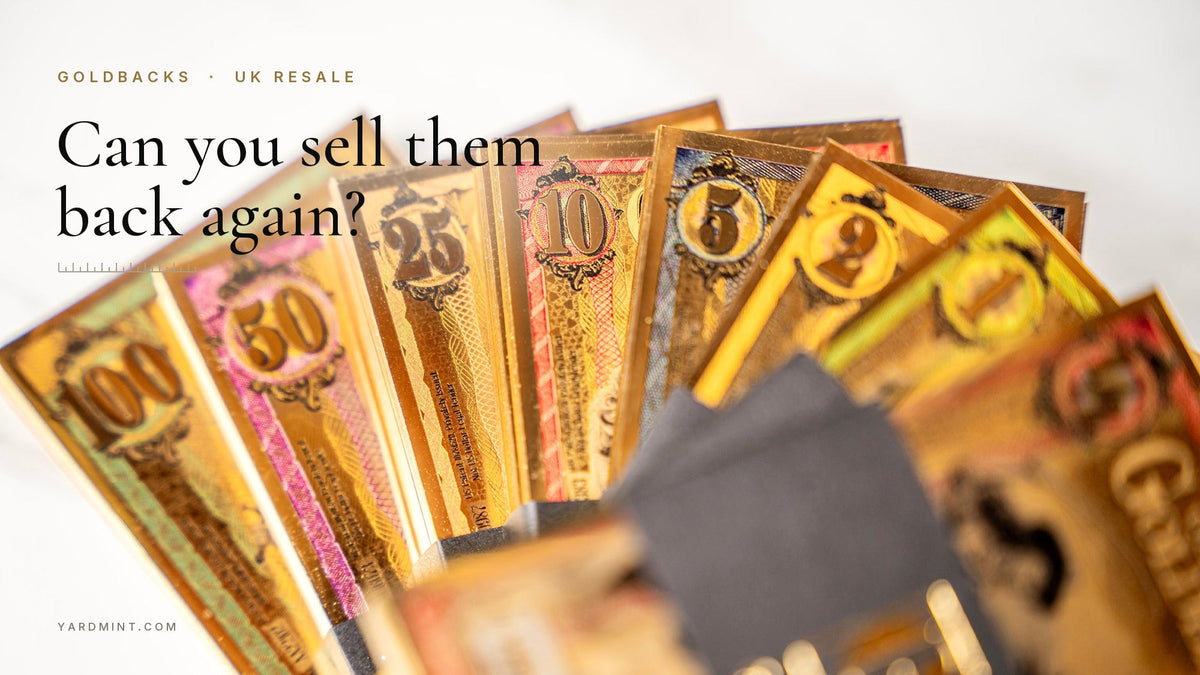
This is the question that stops most first purchases, and almost nobody answers it properly. People are told what a Goldback is worth. They are rarely told what happens when they want the money back out. So here is the honest version: the routes that exist, the one Yard Mint publishes a fee for, and the gap you should expect between the price on the shelf and the number you are offered.
The quick answer
Yes. Goldbacks are legal to own and legal to sell in the UK, and Yard Mint buys and exchanges them. What does not exist is a redemption window: Goldback Inc publishes a daily exchange rate but does not buy notes back from the public, so every route runs through a dealer, a collector or a merchant who agrees to take them. Expect a spread, and expect the premium you paid to be the part at risk.
Five things worth knowing before you sell
- There is no official buy-back. The published exchange rate is a reference number, not an offer to purchase your notes.
- Yard Mint accepts Goldbacks for exchange or vault deposit at a flat ten per cent fee, published in advance, and quotes separately for outright cash sales.
- The gold content is the durable half of the value. The premium is the half that depends entirely on who is buying.
- Spending a Goldback with a willing merchant is the one route that does not surrender the premium, because it changes hands at the exchange rate rather than a dealer bid.
- If quick, predictable resale is your priority, a Britannia or a Sovereign does that job better than any Goldback, and you should know that before you buy rather than after.
Why there is no redemption window
A Goldback is not a claim on a vault somewhere. It is gold, held in the note itself, and there is no issuer standing behind it with an obligation to give you cash on demand. Goldback Inc publishes a daily exchange rate, updated each morning and built from the market value of the gold plus the labour, technology and security costs of making the note, but that figure is a reference for voluntary transactions. It is not a bid.
That matters more than it sounds. With a Britannia, you can walk into a dealer and be quoted against spot within seconds, because bullion coins trade in a deep market with a settled convention. A Goldback has no such convention, so the number you are offered depends on which of the four routes below you take, and how much the person at the other end wants that particular note.

The four ways out
Every route is a trade between speed and price, and the trade only runs in one direction: the faster you want the money, the less of the premium you keep. That is not a quirk of this market. It is the thing you are actually paying for, so it is worth choosing deliberately rather than by default.
| Route | Speed | What it costs you | What you are buying |
|---|---|---|---|
| Sell to a dealer for cash | Days | Most of the premium | Certainty. A firm number from a named business, without having to find a buyer yourself |
| Exchange or deposit with a dealer | Days | A published flat fee | A figure you can work out before anything is posted, and a route into vaulted metal |
| Sell privately | Weeks, sometimes months | Your time, the postage risk and the verification burden | The best price available, if the note is one somebody is actively looking for |
| Spend with a willing merchant | Immediate, where available | Nothing on the premium | The only route that treats the note as a note. Acceptance in the UK is rare |
The fourth deserves a moment, because it is the one people forget. Goldback's own position is that a note spent at the exchange rate does not lose its premium, since both sides are treating the note as the note rather than as scrap gold. The catch is acceptance: Goldbacks are not UK legal tender and no business here is obliged to take them, so this route depends entirely on finding somebody who agrees. Our guide to spending Goldbacks covers where acceptance currently stands in practice.
What you are actually selling
Every Goldback is two things stacked on top of each other, and they behave completely differently when you try to convert one back.

The gold is real, measured and independent of anybody's mood: a 1 Goldback holds a thousandth of a troy ounce of 24-carat gold, and every other denomination is a fixed multiple or fraction of that. Wherever you sell, that content is a floor.
The premium is everything else. It pays for the artwork, the polymer format, the security layer, the manufacture, the carriage and the seller's margin, and you recover it only from somebody who wants those things as much as you did. A refiner does not. A collector might. Goldback premiums explained breaks the premium into its parts, and how much is a Goldback worth sets out why exchange, retail and resale prices are three different numbers that rarely agree.
Why the number you are offered is lower

Four things live in that gap, and none of them is anybody being unreasonable. The premium you paid is only recovered from a buyer who wants that exact note. Whoever buys from you has to resell, so their margin comes out of your price. Insured, tracked carriage runs in both directions and somebody pays for it. And every note has to be checked before an offer can stand, which is time as well as expertise.
Read that list again and notice what it actually is: four people doing four jobs. The gap is not the enemy. The gap is the work, priced. Which is also why an unusually generous offer deserves more scrutiny than a modest one, not less. Anybody quoting a far finer number on a physical note is either not verifying it properly, not insuring it in both directions, or not expecting to be there if the transaction goes wrong.
It follows that Goldbacks reward patience. A gap you can see is not a reason never to buy, but it is a reason to buy with a long horizon, and a reason to be sceptical of anybody presenting a Goldback as a short-term trade. Are Goldbacks a good investment puts the case for and against without the varnish.
The gap belongs to handling, not to gold
These two get confused constantly, and the confusion costs people money. A wide gap is the price of a physical object changing hands: posted, opened, checked, insured, stored and eventually sold on. Metal that never leaves a vault does none of that. So the familiar comparison, that online vaulted platforms are cheap and physical dealers are expensive, is not really a comparison between two prices. It is a comparison between two different products, one of which you can hold.
Yard Mint runs both. The physical route is the one described above, with everything that comes with handling a real object and a real parcel. The vaulted route holds gold and silver Britannias, Silver Eagles and Goldbacks in the vault, where nothing is posted, opened or re-verified between owners, and the spread is low by comparison. Neither is the cheap version of the other. They answer different questions, and the right one depends on whether what you want is the metal in your hand or the margin in your favour.
Selling or exchanging with Yard Mint
There are two separate services here and they answer different questions, so it is worth being precise about which one you want.

The Goldback exchange and deposit service is for swapping notes for other notes, or converting a holding into a vaulted gold balance. You say what you hold, post the notes using an insured and trackable service, and they are verified and recorded securely within forty-eight hours of arrival. The balance then goes into your vault or the exchanged notes are dispatched to you. The fee is a flat ten per cent on every transaction: as the page puts it, for every eleven Goldbacks you deposit or exchange you receive ten. Publishing that number is deliberate. A stated fee is easier to plan around than a quote that arrives after your notes have already been posted.
Selling for cash is handled separately, through the sell gold, silver and Goldbacks form, because a cash price has to be quoted against live pricing on the day rather than fixed in advance. Tell us what you hold and you get the current pricing and the next steps before anything is posted.
Selling privately, and what it really involves
Private sale is where the best prices are, and where the most goes wrong. Goldback's own FAQ points to eBay, Instagram and Reddit as places with active resale histories, often at prices above the average exchange rate, and to a handful of US dealers running buy-back programmes. For a UK holder that last route means export, customs and international carriage on a small, light, valuable parcel, which usually eats whatever advantage prompted the idea.

What a careful buyer wants to see is consistent: the UV response appropriate to the series year, a legible serial number and mintage date, honest photographs of the corners, creases and seal, and a clear statement of series, denomination and whether the note carries the α mark. Notes printed before the 2025 series year do not glow under UV, and that does not make them fake, but you will be asked. How to tell if a Goldback is genuine is worth reading from the seller's side as well as the buyer's, because the checks you can demonstrate are the checks that get you paid.
The rule that saves the most money
Post insured and tracked, both ways, every time. A Goldback is small, light and worth many times what a plain envelope suggests, and the money saved on postage is trivial against the value of a note that never arrives. This applies as much to sending notes to a dealer for a quote as to shipping a private sale.
The second rule: never accept a private buyer's suggestion to move off-platform for a lower fee. The fee is buying you a payment record, and a payment record is the only thing standing between you and an unwinnable dispute.
What moves quickly, and what sits

Condition does more work than most sellers expect. A Goldback is a thin polymer note and it shows handling: creases, scuffs and sun-fading are all visible, all permanent, and all priced in. A complete state set kept together tends to find a buyer faster than the same notes sold one at a time, because it answers a collector's question rather than adding to their pile.
Scarcity claims deserve particular scepticism when you are on the buying side and particular restraint when you are on the selling side. Some issues have published mintages and some do not, and a listing that supplies a number where the mint has not published one has invented it. Our guide to Goldback Limited Early Releases shows how uneven that record actually is.
So which route suits you?
| If you are | Route | Why |
|---|---|---|
| Selling a small holding you no longer want | Dealer cash sale | The admin of a private sale is not worth it on a few notes |
| Consolidating lots of small denominations | Exchange | A stated fee, and you end up with notes you actually want to keep |
| Moving out of collectables into gold weight | Vault deposit | Converts a premium-heavy holding into metal without a cash round trip |
| Holding a complete set or an unusual issue | Private sale | This is the only route that pays for the thing that makes it interesting |
| Needing money this week | Dealer cash sale | Certainty has a price and here you are paying it deliberately |
| Not sure you want to sell at all | Wait | The gap is widest on the day you bought and narrows the longer you hold |
Five mistakes that cost sellers money
Treating the exchange rate as an offer
It is a published reference figure, not a bid, and no dealer anywhere is obliged to meet it. Working out your expected proceeds from the exchange rate alone will produce a disappointment every time.
Selling in a hurry
Every route has a fast version and a patient version, and the fast version always costs more. If the money is not needed this month, the calmest thing you can do is get two quotes and sit on them for a week.
Sending notes before agreeing what happens if you decline
Establish in writing who pays return carriage, and how quickly notes come back, if the quote is not one you want to accept. Reputable dealers answer this without hesitation.
Photographing badly, then blaming the market
In a private sale, poor photographs read as something being hidden. Flat, evenly lit shots of both faces, the corners and the serial number will do more for your price than any amount of description.
Buying with resale as the plan
This is the mistake made at the other end of the transaction, and it is the expensive one. A Goldback bought for its artwork and format that later sells at a spread is a keepsake you eventually parted with. A Goldback bought as a trade is a trade that started well behind.
Who should think twice before buying at all
Anyone whose main measure is gold per pound. Fractional coins beat Goldbacks on premium and on resale simplicity, and Goldbacks versus fractional gold sets out where each one wins. Anyone who may need to liquidate quickly, because a thin secondary market is exactly the wrong thing to own in a hurry. And anyone buying gold primarily for a straightforward UK exit, where Britannias and Sovereigns are the more sensible instruments: both are British legal tender coins with a deep, settled dealer market, so selling one is a matter of a quote against spot rather than a search for the right buyer. Selling gold coins in the UK covers what a dealer checks on each, and which one to part with first.
If coins and bars are what you actually hold, the mechanics are different enough to be worth reading separately. Selling gold and silver in the UK sets out how a dealer builds an offer from weight, purity and the market price, what prices in minutes and what has to be judged, and the mistakes that cost sellers the most.
None of that makes Goldbacks a poor thing to own. It makes them a particular thing to own, bought for the format and the artwork, held for a while, and sold with realistic expectations rather than optimistic ones.
Frequently asked questions
Can you sell Goldbacks back in the UK?
Yes. Goldbacks are legal to buy, own and sell in the UK. Yard Mint buys them for cash by quotation, and accepts them for exchange or vault deposit at a published flat ten per cent fee. You can also sell privately to a collector, though that takes longer and puts the verification burden on you.
Does Goldback Inc buy Goldbacks back?
No. Goldback publishes a daily exchange rate as a reference for voluntary transactions, but it does not operate a buy-back programme for the public. Every route back runs through a dealer, a collector or a merchant who agrees to accept them.
How much will I get for my Goldbacks?
Less than the shelf price, and the size of the gap depends on the route. The gold content acts as a floor; the premium is recovered only from a buyer who values the artwork, the format and the series as you did. A dealer cash sale is the quickest and pays the least, because what you are buying is certainty. A private sale to a collector pays the most and takes the longest, because you are doing the verification work yourself.
Is there a way to avoid the resale gap?
Not on a physical sale, because the gap is the cost of a real object being posted, checked, insured and sold on. You can sidestep it by not moving the metal at all: a vaulted holding stays where it is between owners, so it trades on a much finer margin than anything handled by hand. Yard Mint vaults gold and silver Britannias, Silver Eagles and Goldbacks, and vault deposit is one of the four routes above. It is a different way of owning metal rather than a cheaper version of the same one.
Do I lose the premium when I spend a Goldback?
Goldback's position is that you do not, because a note spent at the exchange rate changes hands as a note rather than as gold by weight. The limitation is acceptance: Goldbacks are not UK legal tender and no business here is obliged to take them, so this depends entirely on finding a willing merchant.
What is the fee to exchange Goldbacks with Yard Mint?
A flat ten per cent on exchanges and deposits, stated in advance rather than quoted on the day. Put another way, for every eleven Goldbacks you deposit or exchange you receive ten. Outright cash sales are quoted separately against live pricing.
Are damaged Goldbacks still worth anything?
Yes, though condition is priced in. The gold content does not change because a note is creased, but collector demand does, and a damaged note will be valued closer to its metal content than a clean one. Photograph any damage honestly, because a buyer will find it and an undisclosed fault turns a sale into a dispute.
How long does it take to sell Goldbacks?
A dealer route is a matter of days once the notes arrive and have been verified, which is typically within forty-eight hours. A private sale can take weeks or months, depending on the notes and how patient you are willing to be about the price.
Sources
Goldback: frequently asked questions
Goldback: the exchange rate and how it is calculated
Goldback: where to exchange
Yard Mint: Goldback exchange and deposit service
This is general information, not personal tax or investment advice. Tax treatment depends on current rules and individual circumstances.
Continue reading
- Selling gold and silver in the UK: what dealers pay
- Selling gold coins in the UK: Sovereigns and Britannias
- Goldback premiums explained
- How much is a Goldback worth?
- How is the Goldback exchange rate calculated?
- Are Goldbacks a good investment?
- Goldbacks vs fractional gold
- How to tell if a Goldback is genuine
- Can you spend Goldbacks?
- Are Goldbacks legal in the UK?
- Buying Goldbacks in the UK
- The Dallas Fort Worth Texas Goldback
- How Yard Mint vaulting works
Selling or exchanging Goldbacks?
Tell us what you hold and we will come back with current pricing and the next steps. Exchange and vault deposit run at a flat ten per cent, published up front, so you can do the arithmetic before anything is posted.
Request a quote