

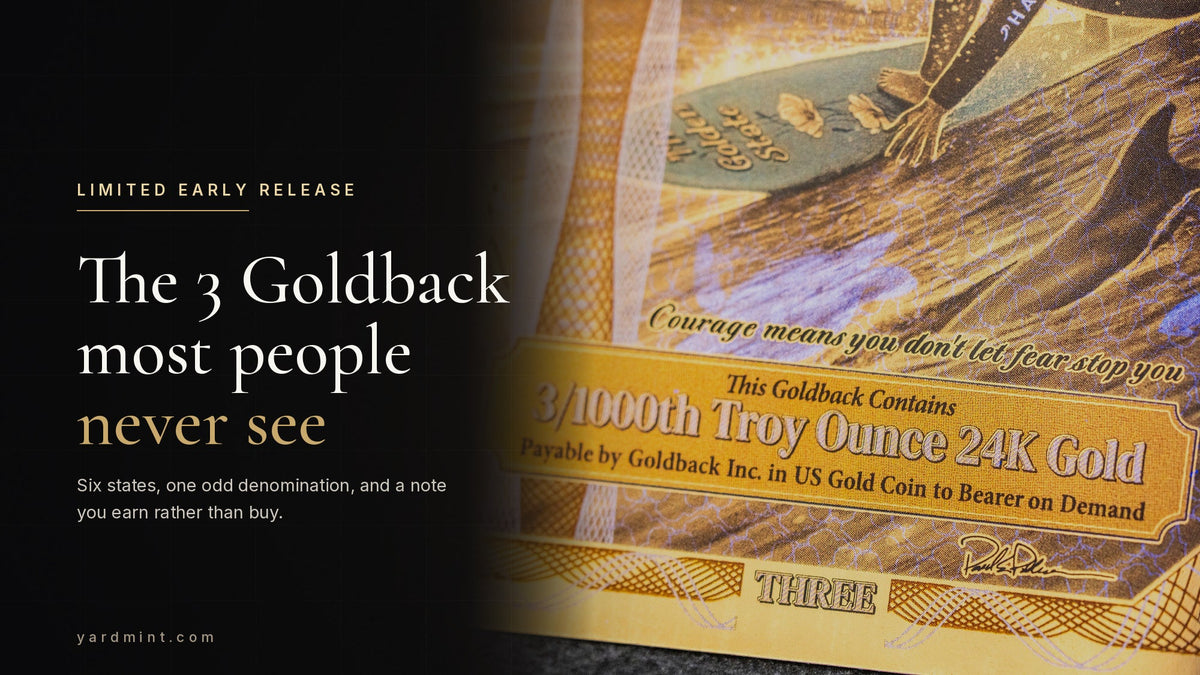
There is a Goldback denomination that almost nobody sells and most collectors have never handled. It is the 3, and it exists for one reason: to pay people for persuading a shop, a garage or a coffee house to start accepting Goldbacks. That makes the Limited Early Release the only note in the whole system you are meant to earn rather than order, which is exactly why it confuses people.
The quick answer
A Limited Early Release, or LER, is a special Goldback issued to launch a state series and to reward people who sign up new merchants. By late 2026 seven states had one: Florida as a 1 Goldback, and Oklahoma, Arizona, Idaho, California, Utah and Nevada as a 3 Goldback. Most are given away through the referral programme, with a small graded batch sold through authorised distributors.
Five things worth knowing
- The 3 denomination exists almost entirely for LERs. It holds 3/1,000 of a troy ounce of 24-carat gold and sits outside the standard ladder.
- The primary route is not purchase. You refer a business, it is approved, and both you and the owner receive a graded note.
- Published mintages are small and inconsistent between states. Idaho is 3,000, Oklahoma and Utah are 4,000 each, Arizona is 6,000 and Florida is 8,000. We have not found a published figure for California or Nevada.
- An LER is not the same thing as an Alpha note, and the two get conflated constantly.
- Yard Mint does not stock LERs. The merchant programme is tied to US states, so a UK buyer's only route is the secondary market, at whatever premium that market decides.
What a Limited Early Release actually is
Goldback's problem has never been making the notes. It is getting real businesses to take them, because a currency that nobody accepts is just a nicely engraved souvenir. The Limited Early Release programme is the answer: a note issued alongside a state series launch and used as the reward for growing the merchant network in that state.
It started in Florida. Goldback issued a Florida LER as a 1 Goldback, then moved the idea to Oklahoma and introduced a new denomination to carry it. Every LER since has been a 3.

The merchant criteria are stricter than people expect. Goldback requires a business that trades year-round, has a physical or mobile presence rather than being online-only, can be verified as real, agrees to appear in the merchant network listing, and is not a multi-level marketing operation. Seasonal traders are excluded. If your referral clears all of that, two notes are issued, one to you and one to the owner.
There is also a consolation arrangement. Goldback states that if your state has no LER yet, both you and the merchant receive a graded Silverback instead, with the state's LER following once that series launches.
Which states have one
Seven by late 2026. Florida came first and is the only 1 Goldback in the group. The rest are 3s. Goldback adds an LER as each new or redesigned series launches, so its LER programme page is the place to check for later additions.

| State | LER denomination | Published mintage | What makes it notable |
|---|---|---|---|
| Florida | 1 Goldback | 8,000 | The first LER, and the only one that is not a 3 |
| Oklahoma | 3 Goldback | 4,000 | Introduced the 3 denomination; Ingenium among yucca and prairie thistle |
| Arizona | 3 Goldback | 6,000 | The largest published LER mintage |
| Idaho | 3 Goldback | 3,000 | Smallest published mintage; Laetitia as a skier in the Smoky Mountains |
| California | 3 Goldback | Not published | Goldback calls it the first colourised LER |
| Utah | 3 Goldback | 4,000 | Celeritas driving a Hudson Speedster on the Bonneville Salt Flats |
| Nevada | 3 Goldback | Not published | Issued in 2026 for the redesigned Nevada series |
Two of those designs are worth describing properly, because they are unusually specific. The Idaho 3 carries Laetitia, joy, drawn as a skier, with the Gem State on her sweater, a chairlift behind her honouring James Curran's 1936 invention, a red fox, a bull elk and a hidden television as a nod to Philo T. Farnsworth. The Utah 3 carries Celeritas, speed, as a 1930s racing driver on the salt flats with California gulls overhead and headlights that light up under UV. Neither reads like a generic allegory.
The 3: a denomination with nowhere else to live
Every Goldback follows one rule. The 1 holds a thousandth of a troy ounce of 24-carat gold, and every other denomination is a multiple or fraction of that. So a 3 holds 3/1,000 of a troy ounce, sitting between the 2 and the 5.

What makes it odd is that the 3 is not part of the ordinary run. You cannot walk into the standard ladder and buy one the way you can a 2 or a 5. It was created for the Oklahoma programme and has stayed an LER denomination ever since, which is why holding one immediately tells another collector how it was obtained. Our guide to Goldback denominations covers the rest of the ladder and how gold content scales across it.
How rare is rare?
This is where the marketing gets ahead of the record. Some LER mintages are published and some are not, and the difference matters more than any reseller's description.

Idaho is the smallest at 3,000 notes. Oklahoma and Utah are both 4,000, Arizona is 6,000, and the Goldback Safe puts the Florida 1 Goldback release at 8,000, which squares with Goldback's separate description of the Oklahoma release as twice as rare as Florida's. That leaves California and Nevada as the two with no published figure we have been able to find.
Oklahoma's distribution is the most transparent of the group and is worth understanding as a template: of the 4,000 notes, 1,500 were released for sale graded 70 with low serial numbers, 2,000 were reserved for merchants and referrers, and notes graded 69 were used as merchant sign-up incentives. Only a little over a third of the issue was ever purchasable.
Why small mintage does not automatically mean high value
Four thousand notes is a small number in bullion terms and an unremarkable one in collecting terms. Value comes from the number of people who want the thing, not from the number that exists, and Goldback collecting is a young field with a thin secondary market. A note with 3,000 minted and 200 interested buyers is not scarce in any way that helps you.
There is a second problem specific to LERs: most of them were given away, not sold, so nobody knows how many are held loose, damaged, spent or forgotten. Published mintage is a ceiling, not a population. Buy an LER because you want the design, and treat any resale as a bonus you have not counted on. Goldback premiums explained sets out how the gap between price and gold content is built.
An LER is not an Alpha
These two get muddled constantly, including in listings, so it is worth being precise.
| Alpha (α) | Limited Early Release | |
|---|---|---|
| What it marks | The first production run of a design | A separate commemorative note tied to a series launch |
| Where you see it | An α beside the mintage date on the face | On the grading label and in the note's own design |
| Denomination | Any denomination in the ladder | Almost always a 3; Florida is a 1 |
| How you get one | Bought normally from any stockist | Earned through the merchant programme, or bought from the small graded batch |
| Typical grading | Usually sold ungraded | Usually sold graded, often 70 |
The α is a mark on an ordinary note. An LER is a different note altogether. A California ¼ Alpha and a California 3 LER have almost nothing in common beyond the state. Alpha Goldbacks explained covers the α mark properly, including the common error of reading it off the serial number, where it does not appear.
The artwork, and the UV layer
LERs are not plain notes. They carry the same engraving density as the standard series and, from the 2025 series year onward, the same UV-reactive ink. The Utah LER puts that to obvious use: the Hudson Speedster's headlights come on under a lamp. The California LER hides a sea turtle swimming beneath the surfer.

One detail for anyone cataloguing a California 3. Goldback's launch announcement describes the artwork as representing Harmonia, harmony. The note itself carries the printed principle "Courage means you don't let fear stop you." If the virtue name matters for your records, check the entry in the Goldback Safe rather than working from the announcement. It is a small thing, but collectors compile from whatever they read first, and the two do not agree.
The security features themselves are the ordinary ones, and they are the ones to check on any purchase. Goldback security features explained sets out what is actually built into the note, in the order worth checking them.
What "PMG 70" means on an LER listing
Most LERs reaching the market are encapsulated and graded by a third-party grading service, which is unusual for Goldbacks generally. A 70 is the top of a 70-point scale, meaning no post-production flaw is visible under magnification. A 69 is one step down and, in practice, indistinguishable to the eye.
Three things follow from that. Grading is why the small sold batches carry the prices they do, since the plastic holder and the label are part of what you are paying for. A graded note cannot be handled, so if the pleasure of a Goldback for you is the weight and the relief on the reverse, a slab removes it. And grade is not authenticity: an ungraded LER from a reputable seller is not a lesser note, it is an unslabbed one.
Can a UK buyer get one?
Not through the programme. The merchant referral route is tied to businesses in specific US states, so it is closed to anyone here in practice. That leaves the small graded batches sold through US distributors, and the secondary market after that, both of which mean import, shipping and whatever premium the seller has decided on.
Yard Mint does not stock Limited Early Releases, and we would rather say so plainly than imply otherwise. What we do hold is the standard series each LER was created to launch, which is the part of the story a collection is actually built from. If you want the states with an LER behind them, the California, Utah, Idaho and Oklahoma guides are the places to start.
Is an LER worth chasing?
| If you are | Verdict | Why |
|---|---|---|
| Building a state-by-state collection | Worth it eventually | The LER is the note that completes a state, and the gap will show |
| Buying your first Goldback | No | Start with a standard note. An imported graded slab is a poor introduction to the format |
| Interested in the artwork | Yes, on merit | The Utah and Idaho designs are among the most specific in the whole system |
| Buying for gold weight | No | 3/1,000 of an ounce inside a graded holder is the least efficient gold you can buy |
| Hoping to resell at a profit | Treat with caution | Thin market, no established price history, and mintage does not create demand |
| A UK buyer wanting simplicity | No | Import, shipping and seller premium sit on top before you own anything |
Four mistakes people make with LERs
Treating an unpublished mintage as a low one
California has no published figure, and when Arizona's was published it turned out to be 6,000, the largest published figure rather than the smallest. An absent number is not evidence of scarcity, and a listing that fills the gap with one has invented it.
Paying an Alpha premium for an LER, or the reverse
They are different things and priced by different logic. Read the listing carefully: an LER slab described as "Alpha" is describing the series it came from, not the note.
Assuming the 3 will eventually enter the standard range
There is no indication of that. It has been an LER denomination since Oklahoma, and buying on the expectation of a future general release is speculation on a product decision nobody has announced.
Buying a slab to feel the gold
A graded LER is sealed. If what draws you to Goldbacks is the relief on the reverse under a thumb, a standard note gives you that and a slab does not.
Who should skip LERs entirely
Anyone buying gold as metal, without hesitation: the combination of a tiny gold content and a collector premium makes this the worst value per gram in the entire range. Anyone who may need to sell quickly, because the buyer for an imported graded 3 Goldback is a specialist and finding one takes time. And anyone who expects to use Goldbacks in exchange here, since they are not UK legal tender and any exchange is a voluntary arrangement between willing parties.
Frequently asked questions
What does LER stand for on a Goldback?
Limited Early Release. It is a special note issued alongside a state series launch, used mainly to reward people who sign up new businesses to accept Goldbacks in that state, with a small graded batch released for sale through authorised distributors.
Why is the 3 Goldback only issued as a Limited Early Release?
The 3 was created for the Oklahoma LER programme and has been used for LERs ever since. It is not part of the standard denomination ladder, so it is not produced for general sale. It holds 3/1,000 of a troy ounce of 24-carat gold, sitting between the 2 and the 5.
Can I get a Limited Early Release Goldback in the UK?
Not through the referral programme, which is tied to businesses in specific US states. The only routes are the small graded batches sold by US distributors and the secondary market afterwards, both of which involve import, shipping and a seller premium. Yard Mint does not stock LERs.
Are Limited Early Releases the same as Alpha Goldbacks?
No. An Alpha is an ordinary note from the first production run of a design, marked with an α beside the mintage date. A Limited Early Release is a separate commemorative note, almost always a 3, obtained through the merchant programme or from a small graded batch.
How many Limited Early Release Goldbacks were made?
It varies by state. Idaho is 3,000, Oklahoma and Utah are 4,000 each, Arizona is 6,000 and Florida is 8,000. We have not found a published mintage figure for California or Nevada.
Do Limited Early Releases hold their premium?
There is no reliable answer yet. Goldback collecting is young, the secondary market is thin, and most LERs were given away rather than sold, so the surviving population is unknown. Treat resale value as uncertain rather than assured, and buy for the design.
Is a graded LER worth more than an ungraded one?
Usually it sells for more, because the encapsulation and the grade are part of what the market is pricing. That is not the same as being a better note. An ungraded LER from a reputable seller is the same issue, and it can still be handled.
Sources
Goldback: the LER programme
Goldback: the Oklahoma LER programme and the first 3 denomination
Goldback: the Utah LER
Goldback: the Idaho LER
Goldback: the California LER announcement
Continue reading
- Goldback denominations explained
- Alpha Goldbacks explained
- The different Goldback series explained
- Goldback state series ranked by collectability
- Goldback premiums explained
- Best Goldbacks to buy first in the UK
- Buying Goldbacks in the UK
- How to tell if a Goldback is genuine
- Are Goldbacks legal in the UK?
- What are Goldbacks?
Browse the series behind the releases
The standard California, Utah, Idaho and Oklahoma notes, held in UK stock, priced in pounds and delivered within the UK.
View all Goldbacks