

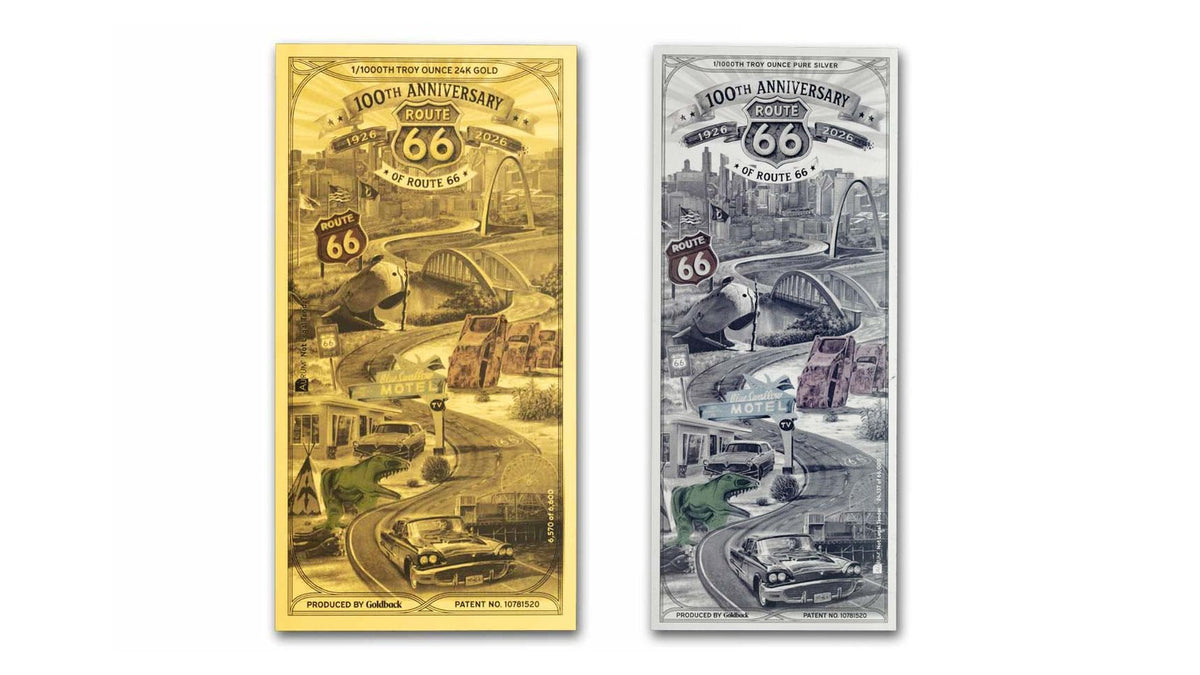
US Route 66 was established in 1926. For its centenary in 2026, Goldback, Inc. produced a commemorative 1 Goldback, released in the US through the dealer APMEX as an APMEXclusive, and a matching Silverback. They are single issues rather than part of any state series, and they are best understood as keepsakes with a measured amount of metal inside. We added both to our range in October 2026.
The short version
The Route 66 Goldback holds 1/1000 of a troy ounce of 24-carat gold, the same as any 1 Goldback. The matching Silverback holds 1/1000 of a troy ounce of .999 silver. Neither is legal tender, and both are priced as collectables, so expect to pay well above the value of the metal.
What it is
Most Goldbacks belong to a state series, with a set of denominations and one virtue on each note. The Route 66 note belongs to the other, much smaller family: single commemorative issues tied to a place or an occasion, like the Washington D.C. and Dallas Fort Worth notes. There is one denomination, the 1, and no wider series to complete.
The design is a collage of the road’s century: vintage cars, Route 66 shields, a river bridge, the Gateway Arch, a roadside motel sign and other landmarks along the way, under a 100th anniversary banner reading 1926 to 2026. It is deliberately busy, a road trip on a single note rather than one stop along it.
What is inside
| Route 66 Goldback | Route 66 Silverback | |
|---|---|---|
| Metal | 1/1000 troy oz of 24-carat (.999) gold | 1/1000 troy oz of .999 silver |
| Denomination | 1 Goldback | 1 Silverback |
| Issue | Route 66 centenary, 2026; an APMEXclusive in the US | Route 66 centenary, 2026 |
| Numbering | Each note numbered on its face, out of 6,600 | Each note numbered on its face, out of 66,000 |
| Format | Metal vacuum-deposited onto polymer and sealed in | Metal vacuum-deposited onto polymer and sealed in |
| Legal tender | No | No |
The numbering is printed on each note: the Goldback reads, for example, “6,570 of 6,600”, and the Silverback is numbered out of 66,000, a nod to the road itself. The gold in a Route 66 Goldback is identical to the gold in any other 1 Goldback. What you pay above that buys the artwork, the manufacture and the occasion. If your aim is the most metal for your money, a bullion coin or bar does that job far better, and our guide to Goldback premiums explains why.
Who it suits
- Goldback collectors who want the commemorative issues alongside the state series.
- Route 66 enthusiasts, and anyone who has driven some of the road, for whom the design is the point.
- Gift buyers looking for a small, inexpensive piece of real gold or silver with a story attached. Pairing the Goldback with the Silverback makes a gold-and-silver centenary set.
It suits buyers less well if quick resale matters. Single commemorative issues have a thin secondary market in the UK, and any collector premium depends entirely on demand.
Questions
Is the Route 66 Goldback real gold?
Yes. Like every 1 Goldback it holds 1/1000 of a troy ounce of 24-carat gold, deposited onto polymer and sealed in. Our guide Are Goldbacks Real Gold? explains how the format works.
Is it part of a state series?
No. It is a single commemorative issue. It sits alongside the state series rather than in one, like the Washington D.C. and Dallas Fort Worth notes.
Can I spend it?
Only where someone agrees to take it. Goldbacks and Silverbacks are not legal tender in the UK, and nobody is obliged to accept one. See Can You Spend Goldbacks?
Sources
APMEX: 1/1000 oz Goldback 100th Anniversary Route 66 Gold Note
General information, not financial advice. Collector premiums and resale values are not guaranteed.
Continue reading
The centenary pair
The Route 66 Goldback and Silverback, priced in pounds and delivered from UK stock.
Route 66 GoldbackRoute 66 Silverback