

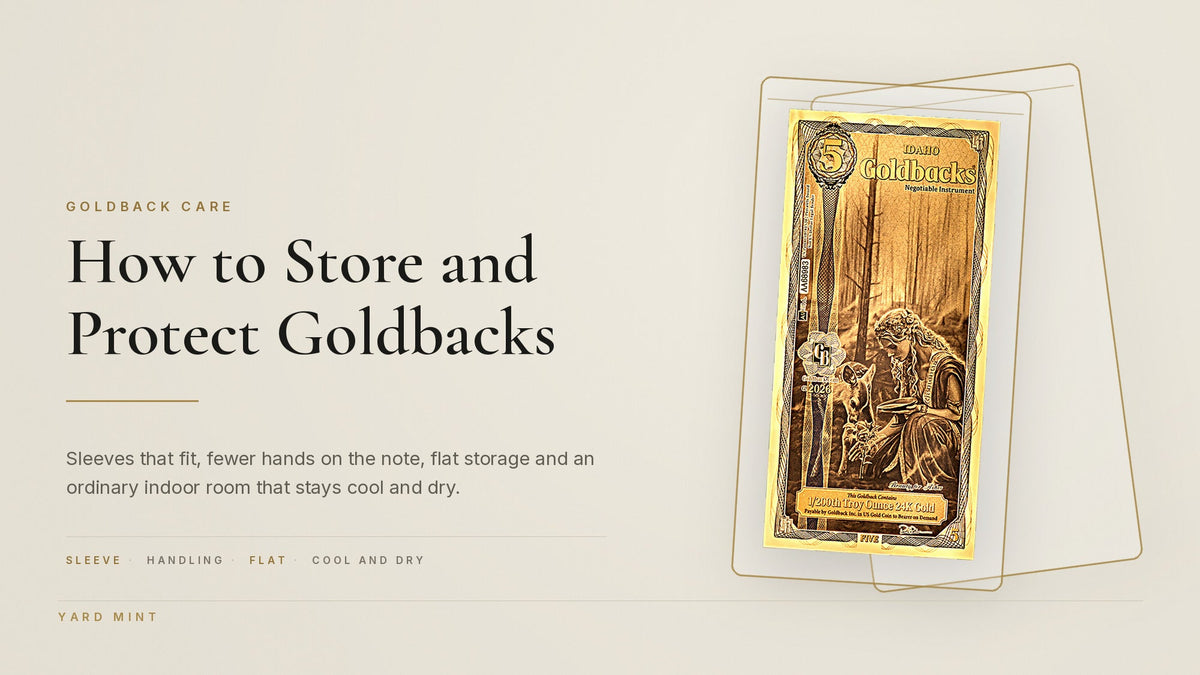
Goldbacks are built for handling, but durable does not mean crease-proof. A good storage setup is simple: reduce handling, give each note proper support and keep the collection in an ordinary indoor place that stays cool, dry and stable.
The short version
- Use one appropriately sized sleeve per note.
- Choose uncoated polyester, polyethylene or polypropylene; avoid PVC and unknown plastics.
- Handle with clean, dry hands and hold the edges where practical.
- Store notes flat, without tight bends, adhesive labels or overstuffing.
- Keep the outer box or safe away from heat, direct sun, damp and water risks.
Why storage still matters
Goldback describes each note as 24-carat gold layered between two polymer sheets. That construction is far more resilient than an unprotected piece of gold leaf, but the finished object can still pick up creases, edge wear and surface marks. Goldback's own FAQ says wear can develop over time and recommends protective sleeves or purpose-made wallets.
The aim is therefore not museum treatment. It is to prevent the ordinary damage caused by repeated removal, tight pockets, unsuitable plastics and poor storage locations. It also has a straightforwardly commercial side: condition is priced in when a note changes hands, as our guide to selling Goldbacks in the UK sets out. A crease costs nothing today and something later.
1. Choose a suitable sleeve
For a collector note, the sleeve is the first line of defence because it reduces direct contact and supports the edges. The Library of Congress lists uncoated polyester, polyethylene and polypropylene as stable plastics for storage, while advising against polyvinyl chloride (PVC) and unknown plastics.
Use a sleeve that is slightly larger than the Goldback, not one that grips it tightly. Place only one note in each sleeve and make sure no corner or edge sits outside. If the sleeve resists, stop rather than forcing the note through it.

Buy sleeves by denomination, not by the packet
Every Goldback shares one width and grows taller as the denomination rises, so a sleeve or wallet pocket sized for a 1 will pinch a 25 or a 50. Check the size you actually need before ordering a box of one dimension; the denomination guide sets out the ladder.

2. Handle the note by its edges
Use clean, dry hands and a clear work surface. Where practical, hold the sleeve rather than the bare note; if the Goldback must come out, support it and handle the edges. Avoid food, drink and loose objects that could scratch or crease the polymer.
Do not attach sticky notes, tape, labels, paper clips or rubber bands to a Goldback. These can leave adhesive, pressure marks or an unwanted bend. Write collection details on the sleeve or on a separate inventory card instead.

3. Store Goldbacks flat
Flat storage is the safest default. A rigid box, binder page or purpose-made wallet can all work if the note is fully supported and nothing forces it around a tight bend. Do not overfill a wallet or album: pressure from neighbouring notes can make removal awkward and catch an edge.
For a working set that you carry, accept that some handling wear is part of use. For a collector set, keep the sleeved notes in a separate box or album and take them out only when needed.
4. Keep the environment cool, dry and stable
Goldbacks do not need specialist cold storage. They do benefit from the same conservative principles used for other flat collectables: ordinary indoor conditions, little fluctuation, no direct heat and no damp. The National Archives advises keeping valuable papers away from hot lofts, damp basements, garages, pipes, windows and known leak risks. Applied cautiously here, those are sensible locations to avoid for a polymer-encased gold note too.
Goldback specifically reports that partial delamination has occasionally occurred in fewer than 0.1% of 50 Goldbacks stored in very humid environments. This is a manufacturer-reported figure rather than an independent failure rate, but it gives a practical reason not to keep higher denominations in a humid room or a damp safe.

5. Box, album, wallet or safe?
There is no single right answer, only a sensible match between how you use the notes and how much protection they need.
| Option | Best for | What to watch |
|---|---|---|
| Protective wallet | A small working set you actually carry and show people | Pockets sized for one denomination. Never force a 25 or 50 into a pocket cut for a smaller note. |
| Album or storage box | A growing collection kept at home and viewed occasionally | Overfilling. Sleeved notes should lift out without flexing their neighbours. Label the page, not the Goldback. |
| Home safe | Higher-denomination notes, and anyone weighing theft or fire risk | Damp. The safe is only the outer layer, so keep every note sleeved inside it and avoid a damp exterior wall. |
| Vault storage | Holdings where value, insurance or access patterns justify professional custody | Whether holdings are allocated, how individual items are identified, and what happens when you request delivery. |
Our guide to home storage versus vaulting explains the wider trade-off, and Yard Mint's own vaulting page sets out how storage with us works.
Which notes deserve the most care
Not every Goldback needs the same treatment. A 1 you carry as a curiosity can live in a wallet. The notes worth protecting properly are the ones where condition carries real weight with the next buyer: Alpha first-production notes, complete sets, and closed denominations such as the discontinued 100, which will never be produced again. If you are still building a collection, buying Goldbacks in the UK covers what to check before the note reaches your desk.
Five mistakes that quietly cost condition
- Buying one packet of sleeves for everything. A mixed collection needs at least two sizes, and the tallest notes are usually the most valuable ones to get wrong.
- Two notes to a sleeve. It looks tidy and saves a few pence. The two faces rub together every time the sleeve is handled.
- An unlabelled soft plastic sleeve. If the packaging does not say what the plastic is, treat it as unknown and use something identified instead.
- Storing the collection "out of the way". Lofts, garages and cellars are exactly the places conservation guidance tells you to avoid, for temperature and damp reasons.
- Trying to fix a mark. Heat, polish, tape and glue turn a small fault into a permanent one. Stop, sleeve it, photograph it and ask first.
What to do with a damaged Goldback
Do not try to flatten a crease with heat, polish the surface or repair a split with tape or glue. Stop further handling, place the note flat in a suitable sleeve and photograph both sides. If the note is still intact, ask the retailer or Goldback's named exchange provider about current replacement arrangements before sending anything from the UK.
Condition questions are easier to resolve when the serial number, denomination and full front and reverse are visible. If authenticity is also in doubt, use our guides to checking whether a Goldback is genuine and Goldback security features.
A five-minute storage check
- Confirm every collector note has its own suitable sleeve.
- Remove PVC, sticky labels, rubber bands and metal fasteners.
- Check that no denomination is folded, pinched or protruding.
- Move the collection away from radiators, sun, damp walls and pipes.
- Photograph the set and record serial numbers separately for insurance and identification.
Frequently asked questions
Should Goldbacks be stored in sleeves?
A sleeve is sensible for any Goldback you want to keep crisp. Goldback itself recommends protective sleeves or a purpose-made wallet, and a sleeve also reduces direct handling.
What type of plastic sleeve is suitable for a Goldback?
Choose an uncoated sleeve made from polyester, polyethylene or polypropylene. The Library of Congress describes these as stable plastics and advises avoiding PVC and unknown plastics.
Can I fold a Goldback?
Goldbacks are made for normal handling, but repeated folding can leave permanent creases. Store collector notes flat and use a wallet that does not force them around a tight bend.
Can humidity damage a Goldback?
Very humid storage is best avoided. Goldback reports that partial delamination has occasionally affected fewer than 0.1% of 50 Goldbacks in very humid environments, so a cool, dry and stable indoor location is prudent.
Can I keep Goldbacks in a normal wallet?
Yes, if the compartment is large enough for the note to sit without folding, catching an edge or being compressed. A Goldback-sized wallet or a sleeve inside a larger wallet gives better support.
How should I clean a Goldback?
Do not use liquid cleaner, polish, tape or an abrasive cloth. If loose dust is present, avoid rubbing; use a clean air bulb gently or leave the note in its sleeve and seek specialist advice for anything more.
What should I do with a damaged Goldback?
Stop further handling, place it flat in a suitable sleeve and photograph the condition. Do not tape, glue, iron or heat it. Ask the retailer or Goldback's named exchange provider about current replacement options before posting from the UK.
Sources and scope: Construction and product-care claims come from Goldback's construction guide and Goldback's FAQ. Sleeve-material and environmental recommendations draw on the Library of Congress preservation FAQ and the US National Archives storage guide. Archival guidance is applied here as a cautious handling framework; those institutions do not publish Goldback-specific advice.
This is general information, not personal tax or investment advice. Tax treatment depends on current rules and individual circumstances.
Continue the Goldback guide
Explore Goldbacks at Yard Mint
Compare current states and denominations using real product photography and live availability.
Browse Goldbacks